
Revisiting Topps’ Entrance Into Baseball Cards with the Overlooked 1951 Baseball Issue 75 Years Ago
PJ Kinsella — October 22 2026
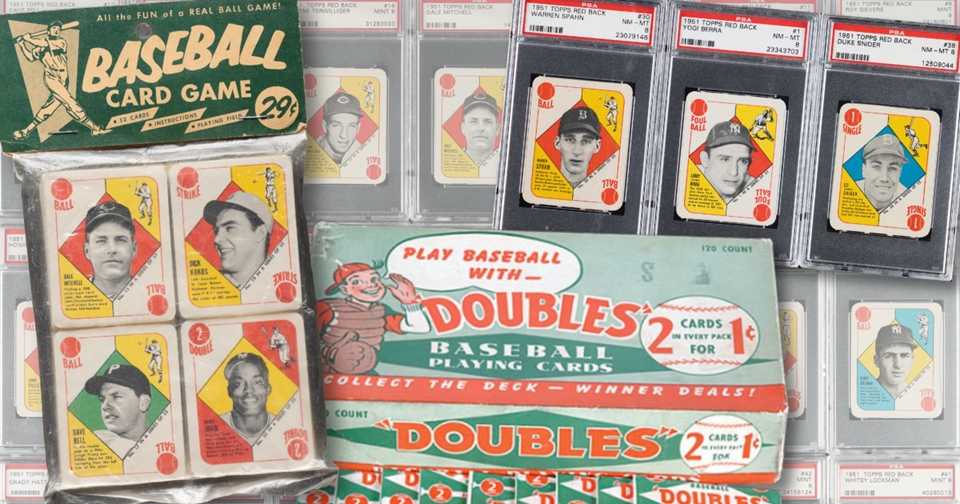
The sights and sounds across baseball in 1951 made it one of the most memorable and important years in the history of our National Pastime. The season had one of the most enthralling final months, with the New York Giants storming back from thirteen games behind the Brooklyn Dodgers to tie their crosstown rival on the final day of the season. This forced a three-game playoff, capped by Bobby Thompson’s legendary “Shot Heard Round the World” in the bottom of the ninth of the deciding Game 3 at the Polo Grounds, sending the Giants to the World Series where they would go on to lose to the Yankees in six games.
While baseball fans were treated to an incredible ending in October, they witnessed the beginning of two incredible careers earlier that season with the debuts of Mickey Mantle on April 17 and Willie Mays on May 25. While the legendary pair would go on to build Hall of Fame careers that rivaled one another in centerfield, their rookie cards would also end up only 52 spots apart in the 1951 Bowman set. To this day they remain two of the most revered first-year cards ever produced.
Meanwhile, Philadelphia-based Bowman was firmly established as the baseball card incumbent. Naturally, with the excitement of baseball season came the anticipation of the latest baseball card issues, and the company had no problem generating fanfare around its 1951 issue.
However, it was an upstart, Brooklyn-based card and gum company named Topps located 90 miles up the New Jersey Turnpike - which, as fate would have it, was also opened for the first time in 1951 - that released its inaugural sets of baseball cards that year to far less pomp and circumstance.
At 2 inches by 2 5/8 inches, the cards were not the traditional size of a baseball card either. Two sets of 52 cards each were produced: one with red backs and one with blue backs. The cards featured player images on the front, a tidbit of biographical information, and one of fourteen possible offensive outcomes: single, double, triple, home run, strike, ball, foul ball, out, hit by pitcher, fly out, foul out, bunt, stolen base, or balk.
While each Topps set that year featured some Hall of Fame names like Yogi Berra, Richie Ashburn, Bob Feller, Duke Snider, Monte Irvin and Ralph Kiner, they did not have the foresight to include the young prospects named Mays and Mantle that would cement the 1951 Bowman set as one of the most celebrated in hobby history.
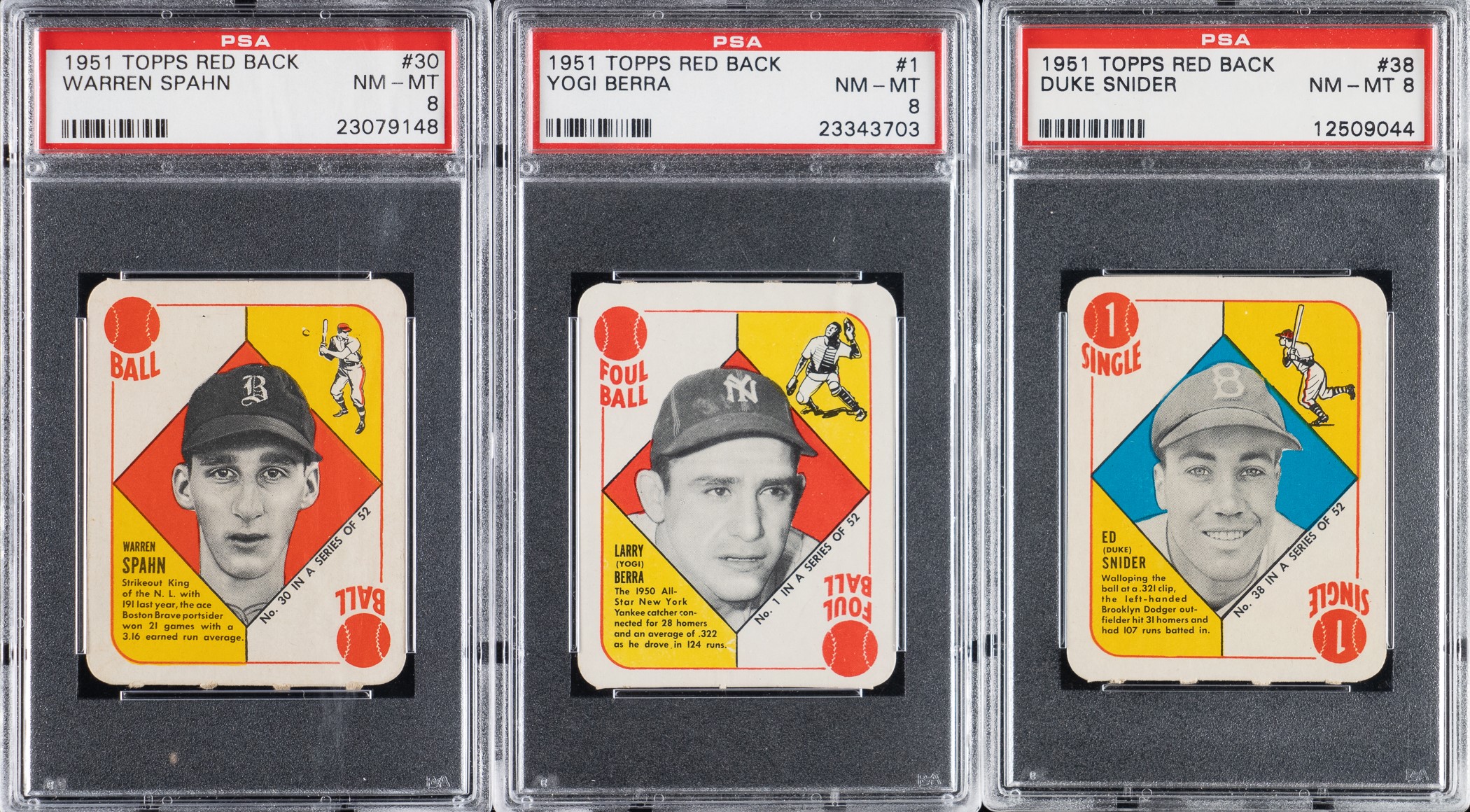
The 1951 Topps set was a playing card game issued in red and blue backs. Hall of Famers Warren Spahn, Yogi Berra and Duke Snider were three of the key cards.
It’s difficult to say for certain whether this omission alone is what led to a lack of interest in this set. What we can say for certain is that kids and collectors alike did not like the gum, they didn’t like the game, and ultimately they didn’t like the cards. At least those who bought them didn’t. The sales - or lack thereof - certainly reflected this.
Topps’ foray into the baseball card market was so underwhelming that a few months after its release, stores were pulling packs of 1951 Topps off their shelves because they were doing little more than taking up space.
It was back to the drawing board for the baseball card newcomers from Brooklyn.
Sy Berger, whose career with Topps would eventually span more than fifty years, was brought in to spearhead the 1952 baseball card design. He knew this one had to stick or it could mean the end of Topps altogether. Stick it did, and not because of the much-improved gum that was included, by the way.
The 1952 Topps set was different, it was simple and it was a huge hit. Not only had Topps created a landmark set, but it made sure to include Mickey Mantle and Willie Mays in this issue, the latter of which had captured National League Rookie of the Year honors following his breakthrough 1951 campaign.
The flop that was Topps’ 1951 inaugural issue seemed like a distant memory and one that Topps would probably love to forget.
Collectors, however, have not forgotten.
Today, 1951 Topps sets and singles remain affordable by comparison, and they continue to hold plenty of nostalgic appeal to vintage collectors, especially those interested in building complete Topps runs. While the “Blue Backs” are more rare, it’s the unopened material from this issue that tends to generate the most interest and strongest results, even though examples do not come up for auction very often.
A 1951 “Red Backs” unopened wax box with 120 packs sold for $25,200 in 2020, while more recently an unopened rack pack of “Red Backs” that included 1951 Topps Connie Mack All-Stars and Topps team cards sold for $19,200 in 2023.
Prices on this pioneering set may not be rising the way other vintage Topps cards have, particularly from the 1950s, but 1951 will forever hold its place as the launching pad for one of the hobby’s most celebrated names.