
A Stint at Fenway: The Mystery Inside a Cigar Box of 1909 Baseball Cards
PJ Kinsella — March 11 2026
Three innings. That’s all Doug Smith got.
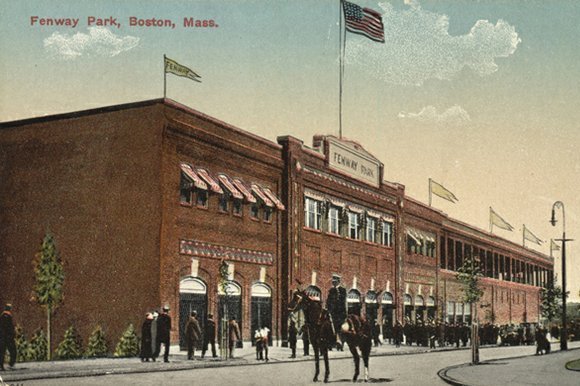
On a blistering 97-degree afternoon at Fenway Park in July 1912, the 20-year-old left-hander took the mound in the seventh inning for the Boston Red Sox. He worked the seventh and eighth scoreless. In the ninth, he gave up a run. The final score was 9–2. It didn’t look like the end of anything.
“Young Smith did very commendable work while he was on the hill-top,” wrote Boston Herald sportswriter R.E. McMillan. “He had fine speed, a sharp breaking curve and good control. After a year or two of seasoning he will be heard from.”
The Potential Behind A Young Star
Smith was pitching for a World Series-winning club that featured Hall of Famers Tris Speaker, Harry Hooper, and ace Smoky Joe Wood, who would win 34 games that season. He looked like he belonged. That afternoon was supposed to be a beginning, but his field of dreams ended just like Moonlight Graham, another one-game wonder.
Within a year, Smith’s name disappeared from the Red Sox roster.
More than a century later, a cigar box stuffed with postcards, letters, and a stack of 1909 baseball cards would help answer the question of why, disclosing a story rich with intrigue and complicated memories of family, baseball and racial history. The box rested for decades in the same house where Smith was born.
“This is the house that my granduncle Doug was born in,” said Smith’s grandnephew, our consignor who asked not to be named and who now lives there.
As a young man, Doug Smith left the quiet mill-town stretch along the Connecticut River and spent years abroad. He lived in Africa. He lived in Europe. He married a French woman. For a time, he and his family lived in Paris.
Then the house came up for sale.
It had been in the family since the 1870s. His grandfather had grown up there. Doug Smith had grown up there. History has a way of leading us back. The grandnephew returned.
By the late 1960s and early 1970s, Doug was aging. His legs were giving out, though his mind remained sharp. His niece, the grandnephew’s mother, began inviting him to Sunday dinners. That was when our consignor really began to know his great Uncle Doug.
“He always liked to say he had a blazing fastball and a toxic spitball,” he remembered.
Doug told stories about dusting hitters off the plate, about slipping a little slippery elm onto the ball when he needed extra bite, and about fighting his way out of New England ballparks after rolling up the score.
He didn’t talk much about the Red Sox. If Fenway was part of his life, it was not a part he chose to remember.
In his final year, Doug’s body began to betray him. His mind was still sharp, but his legs would not cooperate. When the family brought him to a nursing home in Greenfield, the old ballplayer who once fought his way out of hostile parks found himself restrained at night.
“They literally attached him to his bed so he couldn’t get up,” he recalled. “That just broke his spirit.”
Three weeks later, he was gone.

The Discovery of the Cards
After Doug’s death in 1973, the house had to be cleared. Our consignor and his aunt were the ones who did it.
“Among the many things that I really wanted to hang on to was a cigar box,” he said.
Inside the box was more than baseball.
“It had postcards, Christmas cards, letters… things that meant something to him.”
Some were written to Doug. Others were addressed to his mother. There were letters his wife had sent him while he was on the road pitching. There were notes from townspeople. A century of mementos.
And tucked inside that same box was something else.
“Inside was this collection of ball cards.”

His grandnephew remembered opening it in the 1970s and flipping through the small, sepia-toned pieces of cardboard.
“And I didn’t think much of it. They were so small… and the players were obscure.”
The cards didn’t resemble the baseball cards of his childhood in the 1960s. They felt like relics, not treasure. So he put them back and the box went into storage.
“They stayed in that cigar box until about four years ago.”
That was when he mentioned the cards to his son.
“My son Googled some of the players…and it started getting evident that this was of some value.”

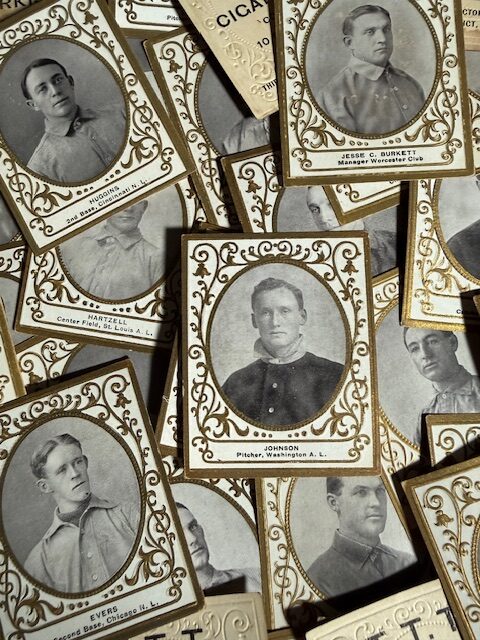
The cards were from the 1909 T204 Ramly Tobacco series featuring ornate, gold-bordered portraits from the dead-ball era. The collection includes nearly 70 of the rare Ramly cards, 36 of which will be offered individually as part of REA’s Spring Catalog Auction that runs April 3-19. The rest will be offered between REA’s May Auction and its Summer Catalog Auction that kicks off in late July.
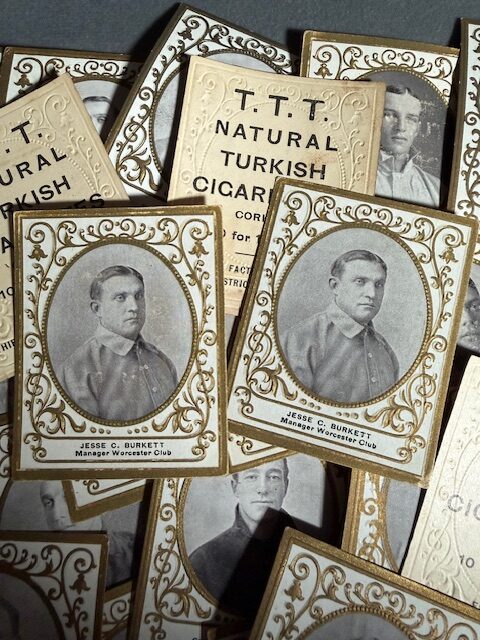
Among the initial 36 that will be offered in Spring are beautiful examples of Hall of Famers Walter Johnson and Jesse Burkett, graded PSA VG-EX 4 and VG+ 3.5, respectively. Six of the cards in Spring feature the extremely rare “T.T.T” advertisement on the reverse, including PSA VG+ 3.5 examples of Hall of Famers Frank Chance and Jimmy Collins.
A second Jesse Burkett card, graded VG 3 by PSA, will be among the 16 cards that will be offered in REA’s Summer Auction. The remaining 17 cards from the collection, which includes a single lot of five ungraded cards, will be offered during the May event that runs from May 7-17.
These cards aren’t just valuable. They are a doorway back to a story that had never been fully told, and one that is still unraveling.

Fading Into Obscurity
Smith didn’t arrive at Fenway Park by accident.
Douglass Weldon Smith was born in 1892 at the family homestead in Millers Falls, Massachusetts. He grew up in a baseball family that dominated local town ball. By his teens, he was the ace of Turners Falls High School, attracting crowds that filled the grandstands.
According to historian Michael Foster in a Society for American Baseball Research (SABR) biography, Smith’s fastball “mesmerized his growing trail of strikeout victims,” and one sportswriter called him “wild as a hawk.”
He earned money pitching semipro ball across New York and, in one stretch, struck out 50 batters in three days. Scouts noticed. The Phillies pursued him, but the Red Sox won the signing battle.
Then came the 97-degree afternoon at Fenway Park. The three innings. The cup of coffee that showed future promise.
Six days later, he was sent to Lowell.

In June 1913, newspapers reported that Doug Smith had quit Lowell on a physician’s advice, “on account of a weak heart.” That was the public explanation. Decades later, Foster, the writer, told our consignor that something more sinister appeared at work.
“I don’t think you want to know,” he told him.
According to Foster, someone in Franklin County at the time allegedly wrote to the Red Sox claiming that Smith had “black blood” and had no right to play for a white club.
The Red Sox, the story goes, dispatched someone to investigate. What they may have found was a complicated lineage. Genealogical research suggests Smith’s father descended from southern Connecticut river tribes, and census records describe relatives as “mulatto.” One family death certificate lists a maternal name followed by a chilling phrase: “Name cannot be known.”
In 1913, baseball’s color line was unwritten but absolute. At the time, the last African American baseball player in the Major Leagues was Moses Fleetwood Walker in 1884.

The box score from Doug Smith’s lone pitching appearance as a member of the Red Sox on July 10, 1912.
The letter, as described in historical accounts, had nothing to do with baseball ability and everything to do with race, according to Foster. But in Millers Falls, the oral history endured. An aunt swore a nephew to secrecy. His mother grew furious when the story resurfaced. Smith’s background continues to be a mystery, one that remains unsolved.
Though Smith never returned to the Majors, he kept pitching. In 1916, playing for Syracuse and facing the reigning World Champion Red Sox in an exhibition game, he “twirled a magnificent game,” Foster writes, defeating Boston 5–2. Babe Ruth was rested that afternoon, but veterans Harry Hooper and Larry Gardner were in uniform.

In 2017, a mural was placed along Newton Strett in Miller’s Falls, telling Doug Smith’s story (Photo courtesy Montague Police Dept. Facebook page).
“There were some bad feelings,” our consignor recalled. “He didn’t want anything to do with the Red Sox.”
While he went on to become a Yankees fan for the remainder of his life, no one could ever take away those three innings in July 1912 at Fenway Park.
About Amar Shah
Amar Shah is a multiple Emmy-winning writer and producer who has written for ESPN.com, NFL.com, The Wall Street Journal, The Orlando Sentinel, Sports Illustrated for Kids, Slam Magazine and The Washington Post. In the 90s, Amar was a teen sports reporter and got to hang out with the Chicago Bulls during their golden era. He even landed on the cover for Sports Illustrated for Kids with Shaquille O’Neal. His debut novel "The Hoop Con" is now available with Scholastic. You can order it here: here.
This story was originally published on Sports Collectors Daily.